
SEO vs Google Ads: Which Is Better for Your Business?
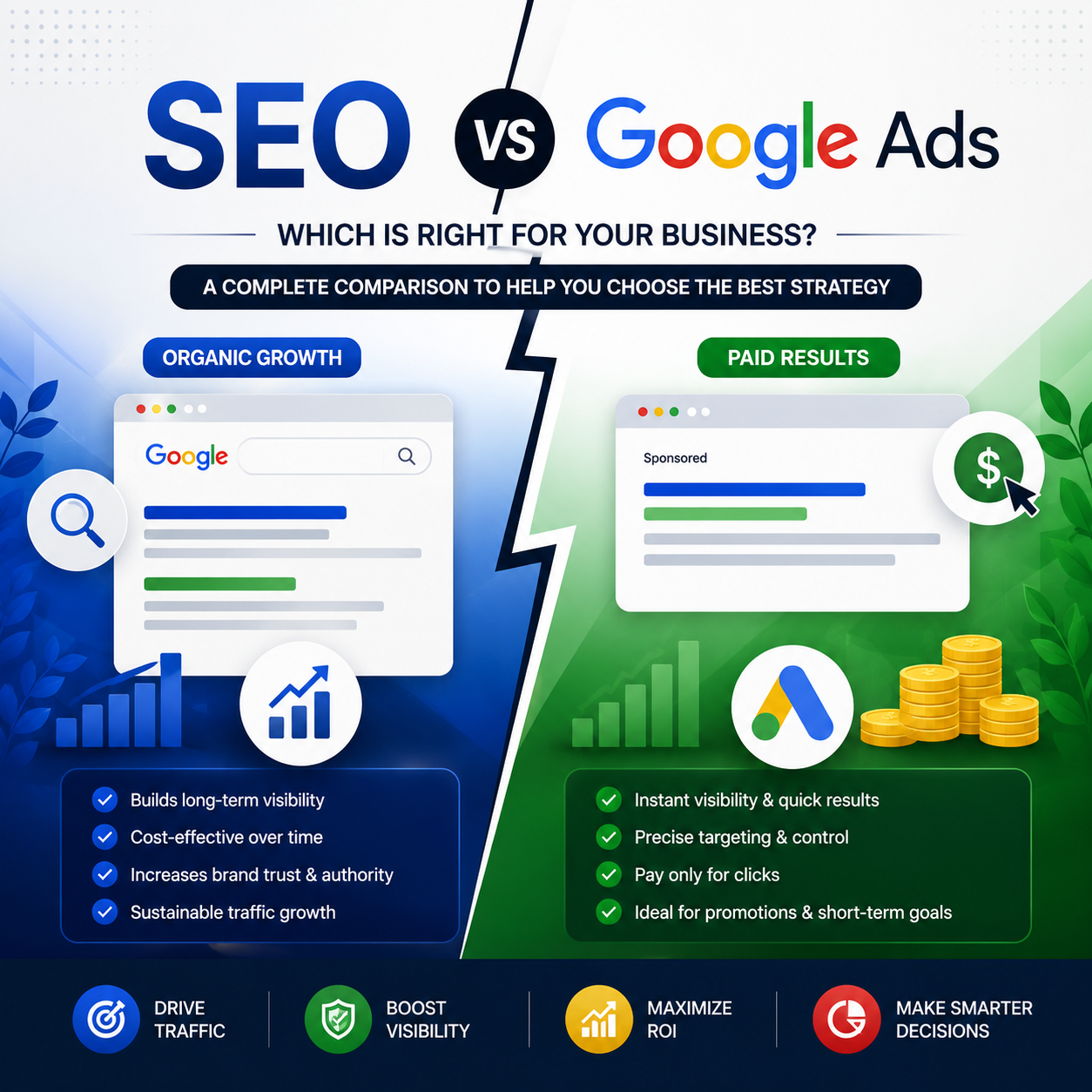
Choosing between SEO vs Google Ads is one of the most important decisions businesses make when planning their digital marketing strategy. Growing a business online has never been more competitive. Whether you’re a startup, a local business, or an established brand, your potential customers are searching for products and services on Google every day. The real question isn’t whether you should market your business online – it’s how you should do it.
Two of the most effective digital marketing strategies available today are Search Engine Optimization (SEO) and Google Ads. Both help your business appear on Google, increase website traffic, generate leads, and ultimately drive sales. However, they achieve these goals in completely different ways.
One of the most common questions I receive from business owners is:
“Should I invest in SEO or Google Ads?”
Unfortunately, there isn’t a one-size-fits-all answer. The right strategy depends on several factors, including your business goals, industry, competition, marketing budget, and how quickly you need results.
For example, if you’ve just launched a business and need enquiries immediately, waiting several months for SEO to produce results may not be practical. On the other hand, if your goal is to build a sustainable online presence that consistently attracts customers without paying for every click, SEO becomes a valuable long-term investment.
Many businesses also assume they have to choose one over the other. In reality, the most successful companies often combine both strategies to maximize visibility, generate consistent leads, and create a stronger return on investment.
In this guide, we’ll cut through the noise and look at SEO vs Google ads based on what actually matters to your business. We’ll look at how each channel works, their real costs, and the kind of ROI you can expect. By comparing SEO vs Google ads, you’ll be able to confidently choose the right strategy for your specific budget, timeline, and growth goals so you can invest your marketing spend where it actually drives results.
Understanding SEO: What It Is, How It Works and Its Benefits
What is SEO?
Search Engine Optimization (SEO) is the process of improving a website so it appears higher in Google’s organic (non-paid) search results. Instead of paying Google to display your website, SEO focuses on helping search engines understand your content while ensuring it provides genuine value to users.
Whenever someone searches for information, products or services on Google, the search engine aims to display the most relevant, trustworthy and useful webpages. SEO helps position your website as one of those results by optimizing your content, website structure and overall user experience.
For instance, imagine you own a bakery in Bangalore. If someone searches for “Best Bakery in Bangalore” and your website appears on the first page of Google’s organic search results, potential customers can discover your business without you paying for every website visit. This visibility is earned through effective SEO rather than advertising.
Unlike paid campaigns that stop generating traffic when your budget runs out, SEO is a long-term strategy. A well-optimized webpage can continue attracting visitors for months or even years with regular updates and maintenance.
However, modern SEO is about much more than adding keywords to a webpage. Google’s algorithms evaluate hundreds of ranking factors to determine which pages deserve to appear at the top of search results. These factors include content quality, website speed, mobile usability, backlinks, user experience and how well a page satisfies search intent.
The primary objective of SEO is simple: Help users find the information they’re looking for while providing the best possible experience on your website.
How does SEO work?
To understand why SEO is important, it helps to know how Google processes websites before displaying them in search results.
Google follows three main steps:
1. Google Crawling Bots
Google uses automated software known as Googlebot to discover webpages across the internet. These bots continuously browse websites by following links and checking for new or updated content.
If your website has broken links, poor navigation or technical issues, Google may struggle to discover all of your pages. As a result, valuable content may never appear in search results.
2. Indexing
Once Google discovers your webpage, it analyzes the content to understand what it’s about.
During this stage, Google looks at various elements, including:
- Page title
- Meta description
- Heading structure
- Keywords and topics
- Images and alt text
- Internal links
- Website structure
- Content quality
If Google determines that your content is valuable and relevant, it stores the page in its search index—a massive database containing billions of webpages.
Think of Google’s index as a digital library. If your webpage isn’t indexed, it cannot appear in search results.
3. Ranking
Whenever someone performs a search, Google evaluates all relevant indexed pages and decides which ones deserve to appear first.
This decision is based on hundreds of ranking factors, including:
- Relevance to the search query
- Content quality and originality
- Search intent
- Website authority
- Backlinks
- Page speed
- Mobile-friendliness
- User experience
- Content freshness
- E-E-A-T (Experience, Expertise, Authoritativeness and Trustworthiness)
Google’s goal is simple: deliver the most helpful answer to every search query. Websites that consistently provide valuable content and a great user experience have a much better chance of achieving higher rankings.
Types of SEO
SEO isn’t a single activity. It’s made up of several disciplines that work together to improve your website’s visibility on search engines.
1. On-Page SEO
On-page SEO focuses on optimizing everything within your website that influences search rankings.
This includes:
- Creating high-quality, original content
- Optimizing title tags and meta descriptions
- Using keywords naturally throughout the page
- Organizing content with H1, H2 and H3 headings
- Improving URL structure
- Optimizing images and adding descriptive alt text
- Adding internal links to related pages
- Improving readability and user experience
Well-executed on-page SEO helps both users and search engines understand the purpose of your content.
2. Off-Page SEO
Off-page SEO refers to activities that improve your website’s authority outside of your own website.
The most important aspect of off-page SEO is earning high-quality backlinks from trusted websites. Backlinks act as recommendations, signalling to Google that other websites consider your content valuable. Other off-page SEO activities include:
- Guest blogging
- Digital PR
- Brand mentions
- Social media promotion
- Local business citations
- Online reviews
The stronger your website’s authority, the greater its chances of ranking for competitive keywords.
3. Technical SEO
Technical SEO ensures your website is easy for search engines to crawl, understand and index. It focuses on improving the technical health of your website by optimizing:
- Website speed
- Mobile responsiveness
- Core Web Vitals
- XML sitemap
- Robots.txt
- HTTPS security
- Structured data (Schema Markup)
- Crawl errors
- Duplicate content issues
Even the best content can struggle to rank if search engines encounter technical issues while accessing your website.
4. Local SEO
Local SEO helps businesses appear in location-based searches such as:
- Digital marketing agency in Bangalore
- Dentist near me
- Best café in Mumbai
This involves optimizing your Google Business Profile, maintaining consistent business information across online directories, collecting customer reviews and targeting location-specific keywords. For businesses that serve a specific city or region, Local SEO is often one of the most effective ways to generate qualified leads.
Benefits of SEO
When implemented correctly, SEO offers several long-term advantages for businesses of all sizes.
Sustainable Organic Traffic
Unlike paid advertising, SEO can continue driving visitors long after content is published. A well-ranked page has the potential to generate consistent traffic without paying for every click.
Builds Trust & Credibility
Users generally trust organic search results more than advertisements. Ranking on the first page of Google helps establish your business as a credible and authoritative source within your industry.
Higher Long-Term ROI
Although SEO requires patience and consistent effort, it often delivers a stronger return on investment over time. Once your pages rank well, they can continue attracting leads with relatively low ongoing costs.
Better User Experience
SEO isn’t only about search engines. Improving page speed, mobile usability, navigation and content quality creates a better experience for visitors, increasing engagement and conversions.
Attracts High Intent Customers
People using Google are actively searching for solutions. This means SEO helps attract visitors who already have an interest in your products or services, making them more likely to convert into customers.
Challenges of SEO
Despite its advantages, SEO also has some limitations.
- Results typically take several months, especially in competitive industries.
- Success requires continuous content creation and optimization.
- Google frequently updates its algorithms, making ongoing improvements essential.
- Ranking for highly competitive keywords often requires strong website authority and quality backlinks.
- SEO is a long-term investment rather than a quick-win marketing strategy.
However, businesses that remain consistent with their SEO efforts often benefit from sustainable growth, increased brand visibility and reduced dependence on paid advertising.
Understanding Google Ads: What It Is, How It Works and Its Benefits
While SEO focuses on earning organic visibility over time, Google Ads allows businesses to appear at the top of Google’s search results almost instantly through paid advertising. It is one of the most effective digital marketing platforms for generating targeted traffic, leads and sales because it connects businesses with users who are actively searching for their products or services.
Whether you’re promoting a local service, an ecommerce store or a global brand, Google Ads provides the flexibility to reach potential customers at different stages of their buying journey.
What is Google Ads?
Google Ads is Google’s online advertising platform that enables businesses to display advertisements across Google’s ecosystem, including
- Google Search
- YouTube
- Google Display Network
- Gmail
- Google Discover
- Google Maps
- Google Shopping
Unlike SEO, where rankings are earned organically, Google Ads follows a Pay-Per-Click (PPC) model. This means advertisers only pay when someone clicks on their advertisement.
For example, if you own a digital marketing agency and someone searches for “Google Ads expert in Bangalore“, your advertisement can appear above the organic search results if your campaign is well-optimized. This immediate visibility makes Google Ads particularly useful for businesses looking to generate enquiries, promote new products, increase website traffic or drive online sales without waiting months for SEO to take effect.
How does Google Ads work?
Google Ads may seem straightforward—create an ad, choose a budget and start receiving clicks—but behind the scenes, Google’s advertising system evaluates multiple factors before deciding which ads appear.
Step 1: Choosing the Campaign Goals
Google Ads may seem straightforward—create an ad, choose a budget and start receiving clicks—but behind the scenes, Google’s advertising system evaluates multiple factors before deciding which ads appear.
Every Google Ads campaign starts with a business objective. Some common goals include:
- Generating leads
- Increasing website traffic
- Driving online sales
- Promoting a mobile app
- Increasing brand awareness
- Driving local store visits
Your campaign objective influences how Google optimizes your advertisements.
Step 2: Keyword Selection
For Search campaigns, advertisers choose keywords that match what potential customers might search for. For example, a digital marketing freelancer may target keywords like:
- SEO freelancer
- Google Ads expert
- Digital marketing consultant
- PPC specialist
- SEO services near me
When someone searches using these keywords, Google determines whether your advertisement should enter the auction. Choosing the right keywords is one of the most important aspects of a successful campaign. Highly relevant keywords generally result in better performance and a higher return on investment.
Step 3: The Google Ads Auction
Every time someone performs a Google search, an instant auction takes place. However, the advertiser with the highest bid doesn’t automatically win. Google considers several factors before displaying advertisements, including:
- Maximum bid
- Quality Score
- Ad relevance
- Expected click-through rate (CTR)
- Landing page experience
- Ad extensions
This means a well-optimized campaign with relevant ads can often outperform competitors who simply spend more money.
Step 4: Quality Score
One of the unique aspects of Google Ads is Quality Score, Google’s rating of the relevance and quality of your keywords, advertisements and landing pages.
Quality Score is influenced by factors such as:
- Expected Click-Through Rate (CTR)
- Ad relevance
- Landing page quality
- Page loading speed
- Mobile usability
- Overall user experience
A Higher Quality Score can:
- Reduce your cost per click (CPC)
- Improve ad positions
- Increase visibility
- Deliver better ROI
Rather than rewarding the biggest advertiser, Google rewards advertisers who provide the best experience for users.
Step 5: Landing Page
A common mistake businesses make is sending users to their homepage after they click an ad. Instead, every advertisement should direct users to a dedicated landing page that matches the search intent. For example:
If someone searches for “SEO Services in Bangalore” they should land directly on your SEO service page—not your homepage.
A high-converting landing page should include:
- A clear headline
- Relevant information
- Strong call-to-action
- Fast loading speed
- Mobile-friendly design
- Trust signals such as testimonials or case studies
Even the best advertisements won’t generate results if the landing page doesn’t meet user expectations.
Types of Google Ads Campaigns
Google Ads offers several campaign types, each designed for different marketing objectives.
1. Search Campaigns
Search campaigns display text advertisements on Google’s search results page when users search for relevant keywords. These campaigns work best for businesses looking to generate leads or sales because they target people with high purchase intent. Examples include:
- Plumbing services
- Digital marketing agencies
- Lawyers
- Dentists
- Consultants
If someone is actively searching for your service, Search campaigns are usually the most effective option.
2. Performance Max Campaigns
Performance Max is Google’s AI-powered campaign type. Instead of creating separate campaigns for Search, Display, YouTube and Gmail, Performance Max automatically shows advertisements across all Google channels using machine learning. It can display ads on:
- Search
- YouTube
- Gmail
- Display Network
- Google Maps
- Discover
- Shopping
Performance Max works well for businesses with clear conversion goals and enough historical data for Google’s AI to optimize effectively.
3. Display Campaigns
Display campaigns show visual banner advertisements across millions of websites, blogs and mobile apps within Google’s Display Network.
These campaigns are useful for:
- Brand awareness
- Retargeting previous website visitors
- Product promotions
- Increasing visibility
Although Display campaigns generally have lower click-through rates than Search campaigns, they are excellent for reaching large audiences.
4. Video Campaigns
Video campaigns allow businesses to advertise on YouTube before, during or alongside videos. These campaigns are ideal for:
- Brand storytelling
- Product launches
- Demonstrations
- Educational content
- Increasing brand awareness
With YouTube being one of the world’s largest search platforms, video advertising has become an essential part of many businesses’ marketing strategies.
5. Shopping Campaign
Shopping campaigns are specifically designed for ecommerce businesses. Instead of displaying text advertisements, Google shows:
- Product image
- Product title
- Price
- Store name
- Customer reviews
These campaigns help online retailers attract customers who are ready to purchase.
6. Demand Gen Campaigns
Demand Gen campaigns are designed to help businesses create awareness and generate demand before customers actively search for their products or services. These ads appear across:
- YouTube
- Discover
- Gmail
They are particularly useful for introducing new products, promoting offers and reaching users earlier in the buying journey.
Benefits of Google Ads
When managed correctly, Google Ads can deliver measurable results faster than almost any other digital marketing channel :
Immediate Visibility
Unlike SEO, Google Ads can place your business on the first page of Google within hours of launching a campaign.
Highly Targeted Advertising
Google Ads allows businesses to target users based on:
- Location
- Language
- Device
- Demographics
- Interests
- Search behaviour
- Previous website visits
This ensures your budget is spent reaching the most relevant audience.
Measurable Performance
Every click, impression, conversion and cost can be tracked. This allows businesses to measure performance accurately and continuously improve campaigns using real data.
Flexible Budget
Whether your daily budget is ₹500 or ₹50,000, Google Ads allows you to control your spending and adjust campaigns whenever needed.
Fast Lead Generation
Businesses looking for immediate enquiries, bookings or online sales often choose Google Ads because results can begin within days rather than months.
Challenges of Google Ads
Although Google Ads is highly effective, it isn’t without challenges.
Traffic Stops When You Stop Advertising
Unlike SEO, Google Ads only generates traffic while your campaigns are active. Once your budget is exhausted or campaigns are paused, your visibility disappears.
Competitive Keywords Can Be Expensive
Industries such as finance, insurance, legal services and digital marketing often have high cost-per-click (CPC) values due to intense competition. Without proper campaign optimization, advertising costs can quickly increase.
Requires Continous Optimization
Launching a campaign is only the beginning. Successful advertisers regularly optimize:
- Keywords
- Bids
- Advertisements
- Landing pages
- Audience targeting
- Conversion tracking
Without ongoing management, campaign performance often declines over time.
Poor Strategy Can Waste Budget
Many businesses assume that simply increasing their advertising budget will produce better results. In reality, success depends on campaign structure, keyword strategy, compelling ad copy and optimized landing pages.
A well-managed ₹1,000 campaign can outperform a poorly managed ₹10,000 campaign.
SEO vs Google Ads: A Detailed Comparison
Both channels can help your business generate website traffic, leads, and sales, but the core of the SEO vs Google ads debate comes down to how they operate. They differ significantly in terms of cost, speed, sustainability, and long-term value. Understanding these specific differences between SEO vs Google ads will help you choose the right strategy based on your immediate business objectives and marketing budget.
| Factor | SEO | Google Ads |
|---|---|---|
|
Cost |
No cost per click, but requires ongoing optimization |
Pay-per-click (PPC) advertising |
|
Time To Results |
3–6 months (or longer) |
Immediate visibility |
|
Traffic |
Organic |
Paid |
|
Long Term Value |
Excellent |
Limited to campaign duration |
|
Credibility |
Higher trust among users |
Marked as “Sponsored” |
|
ROI |
Strong long-term ROI |
Faster short-term ROI |
|
Sustainability |
Stops when campaigns are paused |
Continues generating traffic over time |
|
Competition |
Based on bidding and Quality Score |
Based on content quality and authority |
|
Best For |
Long-term business growth |
Immediate leads and sales |
Cost Comparison
One of the biggest differences between SEO vs Google Ads is how businesses invest their marketing budget. With SEO, you don’t pay Google for clicks or website visits. Instead, your investment goes into creating quality content, optimizing your website, improving technical performance and building authority through backlinks. While these activities require time and resources, they continue delivering value long after the work is completed.
Google Ads follows a Pay-Per-Click (PPC) model, where you’re charged each time someone clicks on your advertisement. The cost per click varies depending on your industry, competition and keyword demand. Highly competitive industries such as legal services, insurance, finance and digital marketing often have significantly higher advertising costs.
If your primary goal is long-term growth, SEO generally offers better value. However, if you need immediate visibility or have a time-sensitive campaign, Google Ads can deliver results much faster.
Winner:
- Short-term: Google Ads
- Long-term: SEO
Speed of Results
When comparing SEO vs Google Ads, if time is your biggest priority, Google Ads has a clear advantage. A properly configured Google Ads campaign can begin generating impressions, clicks and enquiries within a few hours of going live. This makes it an ideal solution for businesses launching a new product, promoting a limited-time offer or entering a competitive market.
SEO, on the other hand, is a long-term investment. Search engines need time to crawl, index and evaluate your content before it begins ranking for competitive keywords. Depending on your website’s authority and industry, noticeable improvements may take anywhere from three to six months, and in some cases even longer. Although SEO takes longer to produce results, those results are often more sustainable and continue generating traffic over time.
Winner: Google Ads
Traffic Quality
Traffic quality is another important factor in SEO vs Google Ads. Both SEO and Google Ads attract users through Google Search, but the nature of the traffic differs. Users who click on organic search results often perceive them as more trustworthy because they know the rankings have been earned rather than paid for. As a result, SEO can generate highly engaged visitors who are actively researching or comparing solutions.
Google Ads also targets users with strong purchase intent, particularly through Search campaigns. Since advertisers can choose specific keywords, locations and audience segments, Google Ads is highly effective at attracting people who are ready to take action. The quality of traffic depends less on the platform itself and more on the quality of your keywords, ad copy, landing pages and overall marketing strategy.
Winner: Tie
Credibility & Trust
Another important aspect of SEO vs Google Ads is brand credibility. Appearing in Google’s organic search results often builds greater trust with potential customers. Many users naturally skip sponsored advertisements because they believe organic rankings are more credible and unbiased.
Ranking on the first page through SEO signals that Google considers your website relevant and authoritative. Over time, this can strengthen your brand’s reputation and increase customer confidence. Google Ads still provides excellent visibility, especially for users ready to purchase, but advertisements are clearly labelled as “Sponsored.” While this doesn’t prevent conversions, some users may prefer clicking organic results instead.
Winner: SEO
Return On Investment (ROI)
Return on investment depends on your business goals and how success is measured. Google Ads often delivers a faster ROI because campaigns can begin generating leads immediately. Businesses with well-optimized campaigns frequently recover their advertising costs quickly through sales or enquiries.
SEO usually requires a larger upfront investment of time and effort, but once rankings improve, traffic continues without paying for every click. Over the long term, this can significantly reduce customer acquisition costs. If your business is looking for sustainable growth over several years, SEO often delivers the stronger long-term return on investment. The ROI of SEO vs Google Ads depends on your business goals and marketing timeline.
Winner:
- Short-term ROI: Google Ads
- Long-term ROI: SEO
Sustainability
Sustainability is one of the biggest advantages in SEO. Once your website achieves strong organic rankings, it can continue attracting visitors with minimal ongoing costs. While regular updates and maintenance are important, you don’t lose all your traffic overnight if you reduce your marketing budget.
Google Ads is entirely budget-dependent. The moment your campaigns are paused or your budget runs out, your advertisements disappear and traffic stops almost immediately. Businesses looking to reduce their reliance on paid advertising should invest in building strong organic visibility through SEO.
Winner: SEO
Which Strategy Is Best for Different Types of Businesses?
There isn’t a single strategy that’s right for every business. The best choice depends on your industry, budget, competition and business objectives.
1. SEO vs Google Ads for Startups
Startups often need enquiries and sales quickly. Since SEO takes time, Google Ads is usually the better starting point. As the business grows, investing in SEO helps build long-term visibility and reduce advertising costs.
Recommended Strategy: Google Ads first, SEO alongside it.
2. SEO vs Google Ads for Local Businesses
Businesses such as restaurants, dentists, gyms, salons and service providers benefit greatly from Local SEO because customers frequently search for nearby businesses. Google Ads can also be valuable for generating immediate enquiries, particularly in competitive locations.
Recommended Strategy: Local SEO + Google Ads.
3. SEO vs Google Ads for Ecommerce Businesses
Online stores often have thousands of products competing for visibility. Google Shopping Ads and Performance Max campaigns can drive immediate sales, while SEO helps product and category pages rank organically over time.
Recommended Strategy: SEO + Shopping Ads + Performance Max.
4. SEO vs Google Ads for Service Based Businesses
Businesses offering professional services—such as consultants, marketing agencies, lawyers or accountants—should prioritize building authority through SEO while using Google Ads to generate immediate leads.
Recommended Strategy: Combined approach.
5. SEO vs Google Ads for Established Brands
Well-established businesses benefit most from using both strategies together. SEO helps maintain long-term visibility, while Google Ads supports product launches, seasonal promotions and remarketing campaigns.
Recommended Strategy: SEO + Google Ads.
Why Using SEO and Google Ads Together Is the Best Strategy
The debate on SEO vs Google ads often forces business owners to think they have to choose one over the other. In reality, the strongest digital marketing strategies don’t treat them as rivals—they combine both to maximize visibility and growth. Google Ads delivers immediate traffic while SEO builds sustainable organic growth. Together, they create a balanced marketing strategy that generates both short-term results and long-term business growth.
For example:
- Google Ads can generate enquiries while your SEO efforts are still gaining traction.
- High-performing Google Ads keywords can help identify topics to target in your SEO content.
- Visitors who discover your business through SEO can later be retargeted with Google Ads.
- Ranking organically while also appearing in paid search increases your brand’s visibility and credibility.
The right choice between SEO vs Google Ads depends on your business goals, budget and growth strategy.
Frequently Asked Questions (FAQ)
SEO vs Google Ads : Which is better for a business?
Neither strategy is universally better. SEO is ideal for long-term organic growth, while Google Ads is better for businesses that need immediate visibility and faster lead generation.
SEO vs Google Ads : Which shows faster result?
Most websites begin seeing noticeable improvements within three to six months. Highly competitive industries may take longer depending on the quality of the website and the SEO strategy.
SEO vs Google Ads : Which is more cost-effective?
SEO generally becomes more cost-effective over time because it doesn’t require paying for each click. Google Ads provides faster results but requires continuous advertising spend.
Does Google Ads improve SEO rankings?
No. Running Google Ads does not directly improve your organic search rankings. Google treats paid advertising and organic search as separate systems.
SEO vs Google Ads: Can both strategies work together?
Yes. In fact, combining SEO and Google Ads often delivers the best results by generating immediate traffic through paid advertising while building long-term organic visibility through SEO.
Ready to Scale Your Business?
Navigating the digital marketing landscape can feel overwhelming, but mastering the fundamentals is the single best investment you can make for your brand’s future. By focusing on the core services that match your current goals, protecting your budget from common trial-and-error traps, and focusing strictly on high-intent customer acquisition, you can build a sustainable growth engine that runs on autopilot.
Remember, you don’t need to conquer every platform overnight. Pick the channels that align with your audience, execute with precision, and scale your budget as you see conversion data back it up.
Let’s Grow Together
Struggling to map out your digital strategy or want to maximize your ad budget for qualified lead generation? Let’s skip the guesswork.
Partner with an experienced digital marketing freelancer.
[Click here to schedule a free strategy consultation] and let’s build a tailored marketing system that turns clicks into customers.