
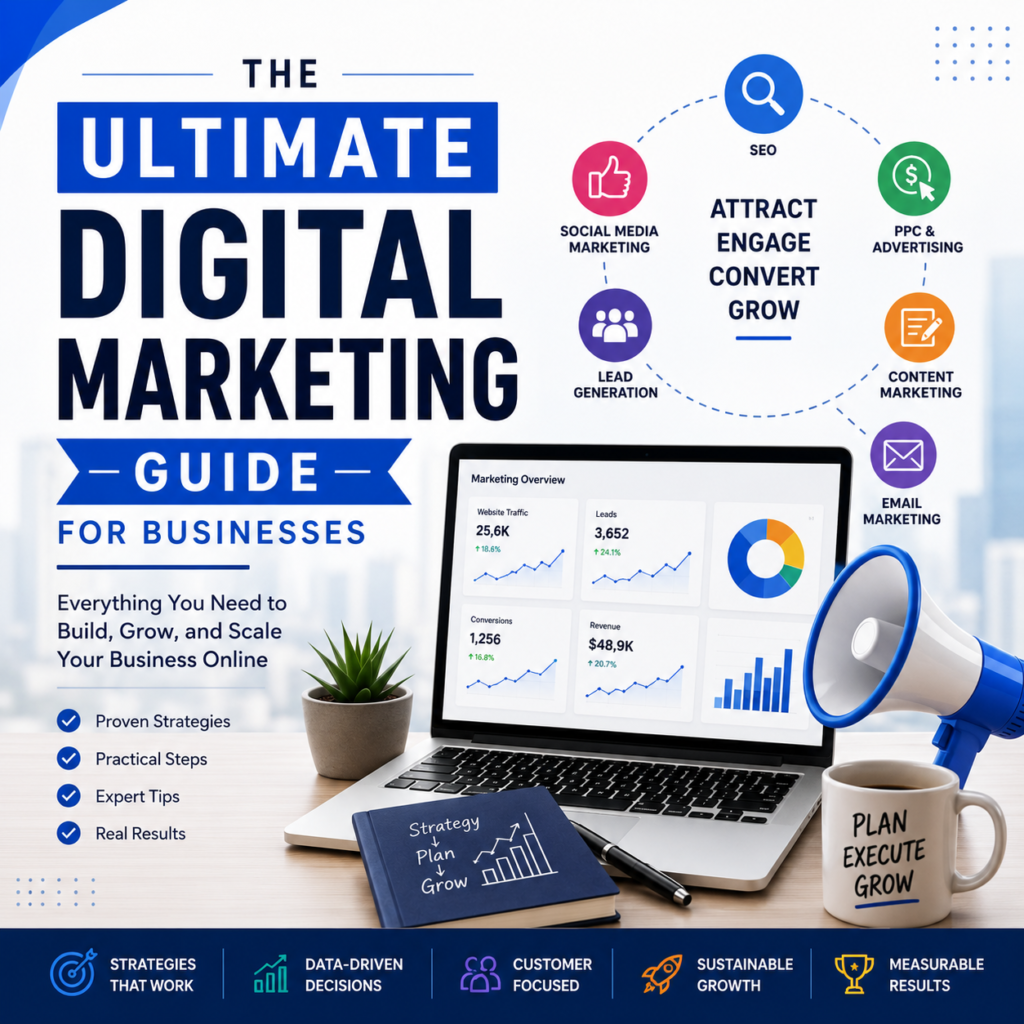
The Ultimate Digital Marketing Guide
In today’s fast-changing business environment, having a strong online presence has become more important than ever. Consumers now spend a significant amount of time on the internet for shopping, researching products, entertainment, and communication. As a result, businesses are adapting their marketing strategies to reach customers where they are most active – online.
From small startups to global companies, brands are increasingly focusing on online platforms to build awareness, engage with audiences, and stay competitive in the market. To navigate this shift effectively, many brands rely on tailored digital marketing services to streamline their efforts. With technology continuing to evolve and consumer behaviour constantly changing, understanding how to build a modern digital marketing strategy has become essential for businesses looking to grow and succeed.
In this blog, we will explore the key aspects of digital marketing, including how it works, its benefits, challenges, different types, and the overall costs involved.
Table of Contents
What is Digital Marketing in simple words?
Digital marketing is the process of promoting products or services through online platforms and digital channels. In simple terms, it refers to businesses using the internet and digital technologies to connect with customers, build brand awareness and increase sales.
Today, consumers spend a significant amount of time online searching for information, watching videos, browsing websites and interacting on social media platforms. Digital marketing helps businesses reach these audiences through targeted online campaigns and digital communication methods.For example, when you search for something on Google, see advertisements on Instagram, watch sponsored videos on YouTube or receive promotional emails from a business, you are experiencing digital marketing.
Unlike traditional marketing methods such as newspapers, radio or television advertisements, digital marketing allows businesses to target specific audiences, track campaign performance in real time and improve strategies using data and analytics. This makes digital marketing a more measurable, targeted and cost-effective marketing approach for businesses of all sizes.
How Does Digital Marketing work?
1. Precision Audience mapping
Digital marketing starts by precisely identifying your ideal customer. By analyzing data points like age, location, specific interests, and real-time online behavior, we eliminate guesswork and ensure your marketing spend is directed only at high-intent prospects.
2. Strategic Content & Multi-Channel Deployment
Once your target audience is mapped, bespoke digital content—ranging from conversion-focused web copy and targeted advertisements to engaging social media assets and emails—is deployed across the channels your customers use most, including Google, social platforms, and mobile apps.
3. Data-Driven Performance Tracking
The moment a user interacts with your brand by clicking an ad, visiting your website, or watching a video, advanced analytics tools log the activity. This gives us immediate visibility into customer behavior, allowing us to accurately measure results and tie your marketing straight to business outcomes.
4. Agile, Real-Time Optimization
Digital marketing thrives on adaptability. By monitoring active campaign performance in real time, strategies can be instantly refined, tweaked, and optimized based on hard data—maximizing your efficiency, lowering your acquisition costs, and boosting your total ROI.
The 12 Types Of Digital Marketing
To build a truly resilient online presence, you cannot rely on a single marketing channel. A scalable growth engine utilizes an interconnected ecosystem of various disciplines, each targeting a different stage of your customer’s buying journey.
If you are looking to build a comprehensive strategy, these are the 12 types of digital marketing you need to master:
1. Search Engine Optimization (SEO)
Search Engine Optimization (SEO) is the art and science of optimizing your website’s technical health, architecture, and content to rank organically on search engines like Google. By aligning your pages with search intent, you secure compounding, high-intent traffic that costs nothing per click.
2. Search Engine Marketing (SEM) & Pay-Per-Click (PPC)
Unlike SEO, SEM relies on paid advertising platforms—primarily Google Ads—to purchase premium real estate at the very top of search engine results pages. It allows you to target users who are actively searching for your exact solutions, yielding immediate visibility and rapid lead generation.
3. Social Media Marketing (SMM)
SMM involves deploying organic content and highly sophisticated paid ad frameworks across networks like Meta (Facebook & Instagram), LinkedIn, and YouTube. It is the ultimate channel for audience demographic targeting, brand storytelling, and building digital communities.
4. Content Marketing
Content marketing focuses on creating and distributing valuable, consistent assets such as deep-dive blog posts, whitepapers, case studies, and infographics. Instead of pitching your products directly, you educate your audience and solve their core problems, building immense industry authority.
5. Email Marketing
Email marketing involves sending automated nurturing sequences, personalized newsletters, and promotional campaigns directly to a subscriber’s inbox. Because you completely own this audience list, it consistently delivers the highest ROI of any digital marketing channel.
6. Performance Analytics & Data Tracking
Data is the lifeblood of digital growth. Utilizing analytics tools like Google Analytics 4 (GA4), this discipline tracks user behavior, maps multi-channel funnels, and attributes conversions. It provides the transparency needed to measure your precise return on investment.
7. Conversion Rate Optimization (CRO)
CRO uses user behavioral data, heatmaps, and A/B split-testing to optimize your landing pages. The goal is to maximize the efficiency of your existing traffic by removing user friction points and increasing the percentage of visitors who complete a form or complete a purchase.
8. Influencer & Creator Marketing
This strategy involves partnering with established content creators, industry thought leaders, or micro-influencers who already command the trust of your target demographic. It allows brands to instantly transfer social proof and credibility to a highly engaged audience.
9. Affiliate & Performance Marketing
An entirely performance-based marketing model where third-party affiliates market your services or products online. The affiliates handle the content and traffic generation, and you only pay them a pre-negotiated commission when a verified sale or lead is secured.
10. Mobile & App Marketing
This pillar focuses entirely on engaging users on their smartphones and tablets. It spans mobile app store optimization (ASO), push notifications, in-app ad placements, and hyper-local, location-based SMS campaigns designed for mobile-first audiences.
11. Video Marketing
Video remains the fastest-growing medium for capturing attention online. By creating high-impact visual content for platforms like YouTube, Instagram Reels, and LinkedIn video feeds, businesses can explain complex B2B solutions or showcase consumer products far more dynamically.
12. Marketing Automation
Marketing automation utilizes software ecosystems to automate repetitive workflows like lead scoring, cart abandonment emails, and social media scheduling. It ensures your marketing engine operates around the clock, systematically moving leads down the funnel on autopilot.
The Bottom Line:
You don’t need to deploy all 12 types of digital marketing simultaneously. True growth happens when a dedicated digital marketing freelancer in Bangalore coordinates the specific three or four channels that directly match your customer’s online buying behavior, maximizing efficiency and scaling your business revenue.
The Core Benefits of Digital Marketing: Why Modern Brands win online
Traditional marketing channels like print, billboards, and television still have their place, but they struggle to compete with the sheer efficiency of digital channels. For growing businesses, switching to digital platforms isn’t just about staying modern—it’s about survival and scalability.
Here are the key benefits of implementing a structured digital marketing strategy:
Advanced Audience & Targeting precision
With traditional media, you broadcast a message to the masses and hope the right person sees it. Digital marketing flips this model. Platforms like Google Ads and Meta allow you to hyper-target prospects based on precise demographics, job titles, exact search phrases, and real-time purchasing behavior. You only pay to get in front of people who are already looking for a solution like yours.
Complete Cost-Efficiency and High ROI
Digital marketing scales to fit any budget. Whether you are a small local brand or an expanding company, you can control your costs down to the penny. With Pay-Per-Click (PPC) frameworks and organic Search Engine Optimization (SEO), your marketing spend is spent directly on high-intent user actions, offering a far higher Return on Investment (ROI) than traditional outbound campaigns.
Real-Time Tracking and Transparent Analytics
The greatest flaw of traditional advertising is the lack of clarity. Digital marketing eliminates guesswork by pairing every single campaign with robust analytics tools like Google Analytics 4 (GA4). You can track a customer’s entire journey in real-time—from the exact second they click an online advertisement to the moment they submit a lead form or complete a purchase.
Continuous, Agile Campaign Optimization
Because you have access to real-time performance tracking data, you don’t have to wait for a campaign to finish to see if it worked. If an ad graphic isn’t performing well or a keyword is burning through budget without converting, you can pause, tweak, and optimize your strategy instantly. This agility protects your ad spend and keeps your strategy highly efficient.
Levels the Playing Field for Growing Brands
In the digital space, a massive corporate budget doesn’t guarantee a win. A highly agile business can outrank a multinational corporation on Google simply by executing a cleaner SEO strategy or creating higher-quality, customer-focused content. Digital platforms give independent businesses the exact same reach and tools as enterprise brands.
Major Challenges in Digital Marketing
Increasing Online Competition
As more businesses invest in digital marketing, competition across search engines, social media platforms and online advertising has significantly increased. Standing out from competitors and capturing audience attention has become more challenging, especially in highly competitive industries.
Constantly changing algorithms
Platforms like Google, Instagram and Facebook frequently update their algorithms, which can affect website rankings, ad performance and organic reach. Businesses need to continuously adapt their strategies to maintain visibility and engagement online.
Generating Quality Leads
Driving website traffic alone is not enough for business growth. One of the biggest challenges is attracting high-quality leads that are more likely to convert into customers. Without proper audience targeting and campaign optimization, businesses may struggle to achieve strong conversion rates.
Rising Advertising Costs
The cost of running paid advertising campaigns continues to increase due to growing competition and higher demand for ad placements. Businesses need effective campaign management and optimization strategies to maintain a strong return on investment (ROI).
Creating Consistent High-Quality Content
Content plays a major role in digital marketing success. However, consistently creating engaging, informative and high-quality content for different platforms can be time-consuming and challenging for businesses.
Keeping up with Digital Trends
Digital marketing trends, consumer behaviour and platform features constantly evolve. Businesses need to stay updated with new technologies, marketing strategies and industry trends to remain competitive in the digital space.
Digital Marketing Strategy and Planning
A strong digital marketing strategy provides a clear roadmap for achieving business goals online. Instead of focusing on random marketing activities, businesses should follow a structured approach that aligns their efforts with measurable objectives. A well-planned strategy helps improve efficiency, maximize return on investment, and create sustainable growth.
Key Digital Marketing steps
1. Define your goals
Start by identifying what you want to achieve. Your objectives may include increasing brand awareness, generating leads, driving website traffic, improving engagement, or boosting sales.
2. Understand your Target Audience
Research your ideal customers, including their demographics, interests, pain points, online behavior, and buying habits. Understanding your audience helps create more relevant and effective campaigns.
3. Conduct Competitor Analysis
Analyze competitors to understand their strengths, weaknesses, marketing channels, and content strategies. This helps identify opportunities to differentiate your business.
4. Choose the Right Marketing Channels
Select channels that best align with your audience and objectives. These may include SEO, SEM, social media marketing, content marketing, email marketing, and performance marketing.
5. Create a Content Plan
Develop content that educates, engages, and supports customer decision-making throughout the buying journey. Consistent content helps build trust and authority.
6. Implement your Campaigns
Launch your marketing activities across chosen platforms while ensuring consistent messaging and branding.
7. Track Performance
Use tools such as Google Analytics, Google Search Console, and conversion tracking to measure performance and identify areas for improvement.
8. Optimize and Scale
Review campaign data regularly and make data-driven adjustments to improve results, reduce wasted spend, and increase overall marketing effectiveness.
Digital Marketing Strategy Framework
A successful digital marketing strategy framework consists of research, planning, execution, measurement, and optimization. Following this framework allows businesses to make informed decisions and continuously improve performance over time.
For businesses operating in competitive markets, including B2B organizations, effective B2B digital marketing strategies focus on building trust, generating qualified leads, nurturing prospects, and supporting long-term business growth.
Ready to Scale Your Business?
Navigating the digital marketing landscape can feel overwhelming, but mastering the fundamentals is the single best investment you can make for your brand’s future. By focusing on the core services that match your current goals, protecting your budget from common trial-and-error traps, and focusing strictly on high-intent customer acquisition, you can build a sustainable growth engine that runs on autopilot.
Remember, you don’t need to conquer every platform overnight. Pick the channels that align with your audience, execute with precision, and scale your budget as you see conversion data back it up.
Let’s Grow Together
Struggling to map out your digital strategy or want to maximize your ad budget for qualified lead generation? Let’s skip the guesswork.
Partner with an experienced digital marketing freelancer
[Click here to schedule a free strategy consultation] and let’s build a tailored marketing system that turns clicks into customers.